Blog
Water Damage Restoration Cost per Square Foot: How Pricing Works
If you’ve ever tried researching water damage pricing, you’ve probably seen big ranges that don’t explain much. The moment restoration companies shift to cost per square foot, everything becomes easier to understand. This method connects the price directly to how much surface area was affected — whether that’s a small patch under a sink or an entire section of living room flooring.
Per-square-foot pricing turns an unpredictable situation into something measurable. It shows how far the moisture really traveled, how many materials were impacted, and how intensive the drying process needs to be. For Anaheim, CA homeowners with different flooring types, wall structures, and home layouts, this is one of the clearest ways to understand restoration costs.
Why Water Damage Is Often Priced per Square Foot
Restoration companies rely on square-foot measurement because water damage rarely affects a whole room equally. Area-based pricing helps match the cost to the actual footprint of the damage.
1. It measures the true impact of the moisture
Water might cover only a small corner or spread across multiple connected areas. Cost per square foot adjusts to the exact amount of space the water reached.
2. It accounts for material-specific differences
Within the same area, you might have:
different flooring types
varying drywall thickness
sections of baseboard or trim
layers of underlayment or insulation
Each material has a different cost and drying difficulty.
3. It eliminates guesswork
Homeowners see the affected space, restoration teams measure it, and both sides understand how the price is formed.
Typical Per-Square-Foot Cost Range
Most water damage restoration jobs fall into a pricing structure based on how much area was saturated.
Typical range: $3 to $8 per square foot
This range reflects common residential conditions, such as clean or lightly contaminated water, moderate moisture spread, and materials that can be partially saved. Within this cost, homeowners are usually paying for extraction, drying, monitoring, and some degree of controlled material removal.
Homes with premium materials or more complex assemblies may fall toward the higher end of the range.
What Influences the Per-Square-Foot Price
Since water damage doesn’t behave the same way in every space, several variables affect how much each square foot of mitigation costs.
1. Type of Water
Clean water costs less.
Grey or contaminated water requires more safety steps and can push the price per square foot upward.
2. Flooring and Wall Materials
Costs differ if the affected space contains:
hardwood vs. laminate
carpet vs. tile
plaster vs. drywall
Harder-to-dry materials increase both labor time and equipment demand.
3. Depth of Saturation
Moisture limited to the surface is less expensive. When water reaches underlayment, insulation, or framing, the cost per square foot increases because more materials must be dried or removed.
4. Equipment Requirements
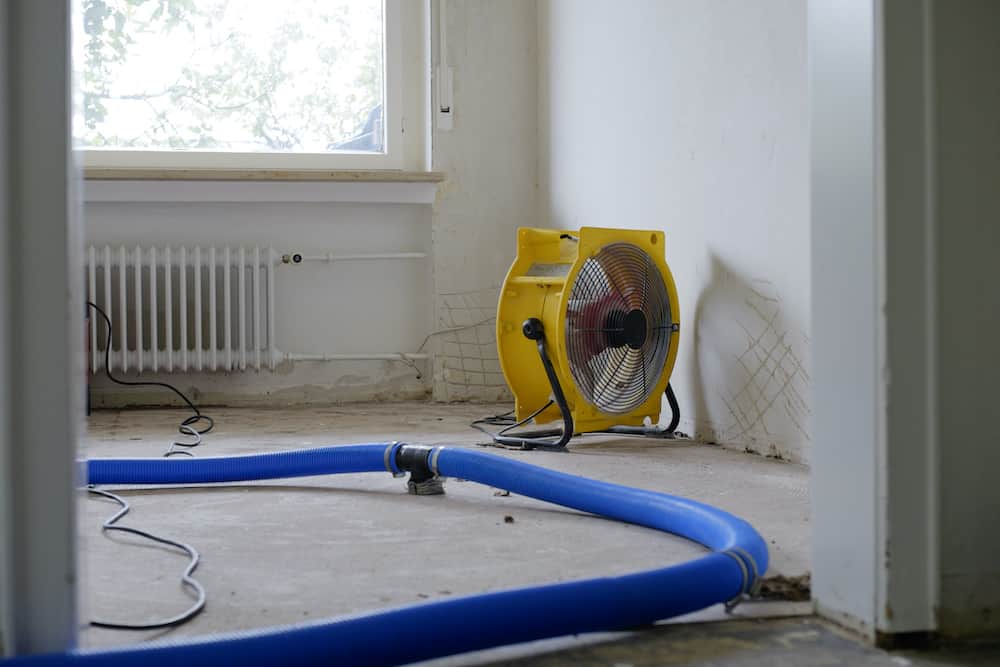
Larger or deeper affected areas need:
more air movers
more dehumidifiers
more time
Every additional day of equipment increases the cost.
5. Accessibility
Open flooring is simple.
Water under cabinets, staircases, or built-ins increases the amount of labor per square foot.
How Square Footage Is Calculated During an Inspection
Restoration teams follow a consistent process to measure the footprint of the damage and determine the corresponding cost.
Step 1: Map the Moisture Boundary
Moisture meters and thermal cameras reveal the exact outline of the wet area, including hidden moisture the eye can’t see.
Step 2: Separate Affected from Unaffected Space
Only the area that needs drying is measured. Rest of the room isn’t included.
Step 3: Identify Layers Affected
Flooring, underlayment, insulation, drywall, and trim are evaluated separately, since each adds cost.
Step 4: Estimate Equipment Needs
The square-foot measurement determines how many air movers and dehumidifiers are required.
Step 5: Finalize the Per-Square-Foot Cost
Once labor, equipment, and materials are assessed, the restoration company applies a per-square-foot rate that reflects the complexity of the job.
Examples of How Per-Square-Foot Pricing Plays Out
These simplified examples help illustrate how the measurement translates to real-world scenarios.
Example 1: 40 Square Feet Affected (Small Leak)
Source: Washing machine hose
Materials: Laminate flooring, light drywall impact
Estimated cost: $300–$600
Typical small-area cleanups fall on the lower end.
Example 2: 180 Square Feet Saturated (Living Room Corner)
Source: Slab leak or rain intrusion
Materials: Carpet and padding, baseboards, drywall
Estimated cost: $1,000–$1,600
More equipment and labor increase the rate.
Example 3: 350 Square Feet Spread Across Two Areas
Source: Appliance malfunction left overnight
Materials: Engineered wood, insulation behind drywall
Estimated cost: $2,000–$3,000+
Wider spread, more layers, and harder-to-dry materials push the cost upward.
FAQs About Water Damage Restoration Cost per Square Foot
Is per-square-foot pricing the final cost, or just part of it?
It’s the foundation of the cost, but not the entire bill. Equipment time, material removal, and repairs may add additional charges. Square footage determines mitigation pricing, while reconstruction is usually calculated separately.
Do all companies use per-square-foot pricing?
Most do, because it standardizes cost across different home layouts and damage patterns. However, some companies include equipment rental and labor as separate line items even when using area-based pricing.
Does per-square-foot pricing include drying equipment?
Yes, the rate usually includes the placement and operation of air movers and dehumidifiers. Extended run times may add extra cost.
Does the price increase for multi-layer damage?
It can. If water reaches subflooring, insulation, or structural wood, the cost per square foot may increase because more materials must be removed or dried.
Can homeowners estimate cost on their own using square footage?
Yes — measuring the wet area gives you a useful starting point. Multiply the affected square footage by the typical range ($3–$8) to get a rough estimate. A professional assessment refines this further by identifying hidden moisture.
Conclusion
Per-square-foot pricing gives homeowners a clearer, more practical way to understand water damage restoration costs. Instead of guessing based on vague ranges, the measurement shows how much of the home was truly affected and how intensive the restoration will be. It connects cost directly to impact — a helpful approach for Anaheim, CA homes where construction materials and moisture behavior vary.
If you need professional support after a leak or sudden water incident, Green Restoration Solutions offers detailed assessments and reliable water damage restoration based on clear, measurement-driven pricing.

Our Services
HelpFul Links
Contact Information
Phone:
Address:
760 N Euclid St #301 Anaheim, CA 92801
Business Hours:
24/7 Emergency Availability
Service area
© 2025 All Rights Reserved | Green Restoration Solutions